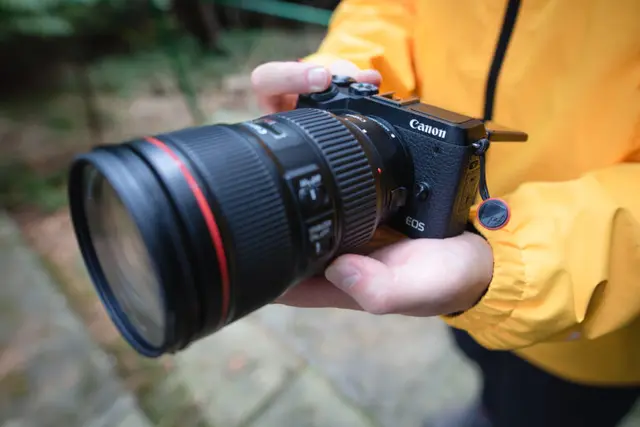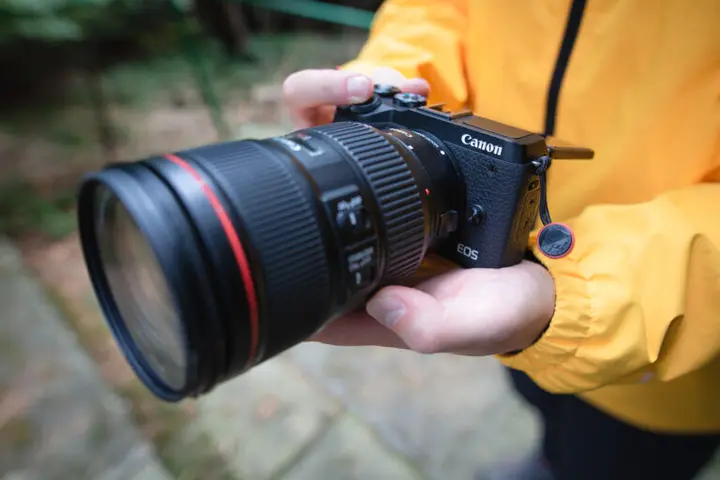
Canon EOS R: Canon's first full-frame mirrorless camera
In 2018 Canon introduced the EOS R: its first full-frame mirrorless camera, and with it the new RF mount. For many photographers, me included, it was the first step from the world of DSLRs into mirrorless. How do I see the EOS R today?
Key specs
- 30.3 MP full-frame sensor, DIGIC 8.
- Dual Pixel AF with 5,655 focus positions, eye detection.
- 3.69-million-dot electronic viewfinder.
- Fully articulating touchscreen.
- 8 fps bursts (5 fps with tracking).
- One SD UHS-II slot.
- 4K 30p with a 1.74× crop.
- No in-body stabilisation (IBIS).
Moving from a DSLR
Coming from the Canon 6D Mark II, the move was natural. The ergonomics are similar, the menus the same, and through the EF-EOS R adapter every EF lens works with no loss of quality. The biggest change: the electronic viewfinder. You see the exposure before you press the shutter, at night and in sunshine. After a few days I didn't want to go back to an optical viewfinder.
What I enjoyed
- Image quality. 30 MP is a good compromise between detail and file size.
- Dual Pixel AF focuses accurately across the whole frame.
- The vari-angle screen for low compositions and video.
- The shutter closes when you change lenses, so dust stays off the sensor.
What I missed
- Sensor stabilisation. With unstabilised lenses you need a tripod or a faster shutter speed.
- One slot. A risk of losing data in professional work.
- The M-Fn bar. The touch bar next to the viewfinder was an idea that didn't catch on: I kept pressing it by accident.
- 4K video with a big crop and no Dual Pixel AF in 4K.
- Battery life: about 370 shots (CIPA).
Who the EOS R suits today
Second-hand, the EOS R is a very affordable full frame. For beginning landscape and portrait photographers, and for those moving from a DSLR with EF lenses, it's a great choice. If you shoot action or video, go for the Canon R6 or R5.
Verdict
Pros: image quality, Dual Pixel AF, vari-angle screen, second-hand price, EF compatibility. Cons: no IBIS, one slot, slow bursts, crop in 4K.
Faq
Does the Canon EOS R have image stabilisation?
No, the EOS R has no sensor stabilisation. The lens has to stabilise.
Do EF lenses work on the Canon EOS R?
Yes, through the EF-EOS R adapter with no loss of quality and full autofocus.
Is a second-hand Canon EOS R worth it?
Yes, for landscapes and portraits it's a cheap way into full-frame mirrorless.